Short Version
HbA1c measures the percentage of your haemoglobin that has glucose stuck to it. Because red blood cells live about three months, it reflects average glucose over that period. It moves slowly, it cannot show a single bad week, and several common conditions make it unreliable.
How The Test Works
Glucose in your blood binds to haemoglobin, the protein in red blood cells that carries oxygen. This happens without any enzyme involved, at a rate that depends simply on how much glucose is around. Once attached, it stays attached for the life of the cell.
Red blood cells live roughly 120 days. So at any moment your blood contains cells of every age from brand new to nearly finished, and the proportion of them carrying glucose is a weighted average of the last few months.
Weighted is the important word. The most recent month contributes about half the result, and the two months before that contribute the rest. It is not an even average.
What The Numbers Mean
| HbA1c | Category | Roughly equals average glucose |
|---|---|---|
| Below 5.7% | Normal | Under 117 mg/dL |
| 5.7 – 6.4% | Prediabetes range | 117–137 mg/dL |
| 6.5% and above | Diabetes range | 140 mg/dL and above |
These are the commonly used US thresholds. A single result in the second or third row is a reason to see a doctor and have it repeated, not a diagnosis on its own and certainly not a reason to buy a supplement.
Why It Lags, And What That Means For You
If you change something today, HbA1c will not fully reflect it for about three months. Partial movement shows up sooner — six to eight weeks — because the newest cells dominate the weighting.
Two practical consequences. First, testing A1c more often than every three months mostly measures noise. Second, a supplement trialled for four weeks cannot be judged on an A1c, because the number has not had time to move.
That is one reason the routine page suggests writing down how the afternoon feels rather than chasing a laboratory number in month one.
Four Situations Where A1c Is Unreliable
The test assumes red blood cells live a normal length of time. When they do not, the result misleads.
- Anaemia. Iron deficiency anaemia can push A1c falsely high. Haemolytic anaemia, where cells break down early, pushes it falsely low.
- Recent blood loss or transfusion. Both scramble the cell age distribution.
- Haemoglobin variants. Sickle cell trait and thalassaemia interfere with several assay methods. This matters disproportionately for people of African, Mediterranean and southeast Asian descent.
- Kidney or liver disease, and pregnancy. Each alters red cell turnover.
If any of those apply to you, ask whether a fructosamine test or continuous monitoring would be a better measure. This is a question for a doctor, and it is a good one to bring.
A1c and a supplement. No supplement on the market has been shown to move HbA1c in a way that changes clinical outcomes, and nothing on this ingredient panel should be expected to. Berberine has A1c data at full standalone doses, and Berberine explains why a blend cannot deliver those.
A1c Versus A Finger-Prick Reading
They answer different questions and neither replaces the other.
A finger-prick tells you what your glucose is doing right now, which is what matters if you are managing medication or want to see how a specific meal behaves. A1c tells you the shape of the last three months, which is what matters for long-term risk.
Someone can have a normal A1c and large daily swings, or a raised A1c with unremarkable morning readings. Two people with identical A1c results can have very different days.
What To Do With A Result You Do Not Like
- Have it repeated. A single result is not a diagnosis, and laboratories vary.
- Ask about the four situations above. If any apply, the number may not mean what it appears to.
- Ask what the doctor wants to do. That conversation is the whole point of the test, and it is not a conversation a supplement page can have with you.
- Change one thing and give it three months. The test cannot answer faster than that, and expecting it to is how people give up on things that were working.
The clinic article covers which numbers mean an appointment rather than a purchase.
Questions On This Article
What readers ask after reading it.
What does HbA1c actually measure?
The percentage of your haemoglobin that has glucose attached to it. Because red blood cells live about 120 days, it reflects average glucose over roughly three months.
How often should A1c be tested?
Every three months at most for someone making changes, because that is how long the number takes to move. Testing more often mostly measures noise.
Can a supplement lower A1c?
Berberine has A1c data at full standalone doses of 900 to 1,500 mg daily. No supplement has been shown to change clinical outcomes through A1c, which is a different claim.
Why might my A1c be wrong?
Anaemia, recent blood loss or transfusion, haemoglobin variants such as sickle cell trait, and kidney or liver disease all interfere by altering red cell lifespan.
Is A1c better than a finger-prick test?
They answer different questions. A1c shows the shape of three months; a finger-prick shows the current moment. Neither replaces the other.
Three More Articles
Ingredients Named Above
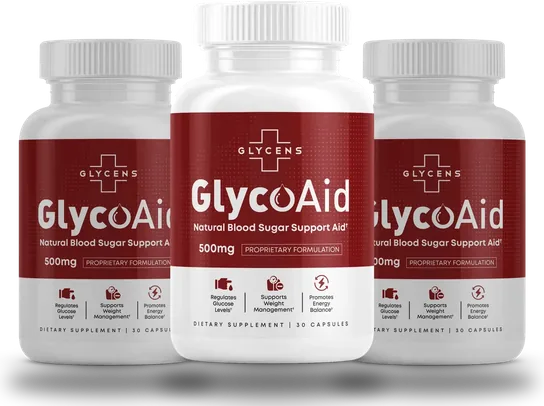
Order Your GlycoAid Today
One capsule with a meal, a page for every name on the label, and sixty days to send it back if it does nothing.
- One capsule a day, taken with food
- Fourteen names, every one with its own page here
- Free US delivery on the 3 and 6 bottle packs
- Sixty days to send it back, opened bottles included