Home›Frequently Asked Questions
Every GlycoAid Question, Answered
Thirty-six questions in six groups. Brief answers throughout, each pointing at a longer page where one exists.
The Basics
What is GlycoAid?
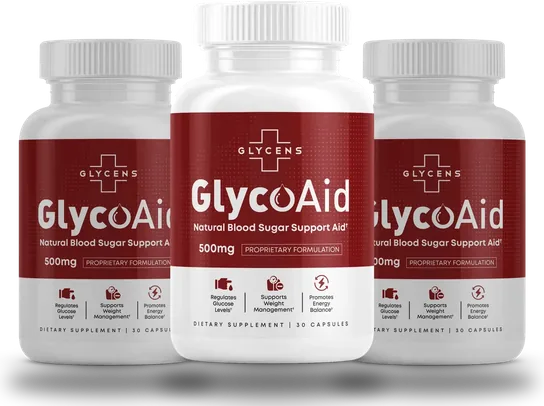
A once-daily capsule sold as a natural blood sugar support aid, built around a 500 mg proprietary blend of fourteen botanical, vitamin and mineral ingredients. One bottle holds thirty capsules, which at the stated serving is a month.
Who makes it?
It is sold under the Glycens brand. The packaging describes manufacture in the United States in an FDA-registered, GMP-compliant facility.
Is it a medicine?
No. It is a dietary supplement, a food category rather than a drug one. No supplement carries FDA approval, and none is meant to diagnose, treat, cure or stop any illness.
How many capsules in a bottle?
There are thirty in a bottle, so one daily makes it a month.
Is it vegetarian?
The capsule shell is vegetable cellulose rather than gelatin, and the packaging carries a vegetarian badge. Check your own bottle to confirm.
What are the other ingredients?
Vegetable cellulose for the capsule shell, rice flour as a filler and magnesium stearate as a flow agent. All three are routine and none of them is a cause for concern.
Taking It
How many should I take?
One a day with a meal. The label does not offer a second, and doubling a proprietary blend doubles the licorice along with everything else.
What time of day?
Whichever meal you eat most reliably. Breakfast is the version most people keep, and consistency matters more than the specific hour.
Does it have to be with food?
It matters more here than usual. Two ingredients are hard on an empty stomach and two only work if they are present when starch arrives.
What if I miss a day?
Take the next one at the usual meal. Nothing in this formula builds up over time, so a skipped day leaves no gap behind it.
Can I open the capsule?
You can, for the gymnema tongue test, and it will taste extremely bitter. For daily use, swallow it whole with water.
How long before anything happens?
Anything appetite-related tends to appear in weeks two and three. Give it a month before deciding, and two months if you can.
Can I take it with coffee?
Yes. There is no caffeine on this panel, so nothing here adds to your daily total.
Do I stop before a blood test?
Tell whoever takes the sample that it contains biotin. Most laboratories ask for a few days off beforehand, because biotin interferes with several common assays.
What Is In It
What are the fourteen ingredients?
Berberine, cinnamon bark, gymnema sylvestre, banaba leaf, bitter melon, alpha-lipoic acid, chromium, biotin, white mulberry leaf, turmeric root, juniper berry, maca root, goji berry and licorice root. Each has its own page here.
Are the amounts printed?
Only for chromium and biotin, which carry percent daily values as micronutrients. The twelve botanicals share one 500 mg blend weight with no individual figures.
How much berberine is in it?
Not printed, and necessarily far below the 900 to 1,500 mg used in trials, because that is two to three times the weight of the entire blend.
Which ingredient is strongest?
Berberine has the best research on its own. The ones most likely to be working at this dose are banaba and white mulberry, because their research doses actually fit.
Which is weakest?
Juniper berry and maca root, both of which have essentially no human glucose evidence. Their pages say so plainly.
Is there caffeine in it?
No, and none of the fourteen names carries any. That is unusual in this category and a genuine point in its favour for anyone sensitive.
Is there anything hidden in it?
No stimulant blend, no ephedra, no synephrine, no yohimbine. There is also no black pepper extract, which matters because piperine is the standard fix for turmeric absorption.
Results And Expectations
Will it lower my blood sugar?
It is sold as support for glucose already within a normal range, which is a narrower statement. It is not a treatment for diabetes and this site does not claim it lowers anything in the medical sense.
Will it help me lose weight?
Indirectly at best, by way of appetite, and only where that change actually alters what gets eaten. Nothing here burns fat or blocks calories.
Nothing happened after a month. Now what?
That is a real outcome rather than a failure to try. Responses vary a great deal. Claim inside the two-month window instead of ordering again on hope.
Does it work the same for men and women?
Yes. No name on this panel acts differently in men and women, whoever the packaging shows.
Does it do anything if the rest of my week stays identical?
Unlikely to be noticeable. The mechanism most likely to be active affects how a meal is digested, so there has to be a meal for it to act on.
Should I buy berberine separately instead?
If berberine at a researched dose is what you want, yes, and that is the honest answer. A standalone product at 500 mg three times daily is what the trials used.
Safety
What are the side effects?
Bloating and gas early on, mild stomach unease, and loose stools in a minority. Taking it with food prevents most of it.
Who should not take it?
Anyone under 18, pregnant or breastfeeding; anyone with high blood pressure, kidney disease or a rhythm problem because of the licorice; anyone with a liver problem; and anyone on glucose medication who has not spoken to a doctor.
Can I take it with medication?
Take your complete medication list to a pharmacist before you start. Glucose medicines, warfarin, diuretics, digoxin, blood pressure tablets, levothyroxine and cyclosporine are all on the list worth raising.
Does it affect blood tests?
Yes, through its biotin content. Biotin interferes with several common immunoassays including thyroid and cardiac troponin. Tell whoever takes your blood.
Is it safe with diabetes?
Put that to whichever clinician is handling the condition. Six of the fourteen names push glucose in the same direction as the medication.
Why is licorice a problem?
Glycyrrhizin blocks an enzyme that shields a kidney receptor from cortisol, which leads to sodium retention, potassium loss and rising blood pressure at sustained intakes.
Should I stop before surgery?
A fortnight beforehand is the usual instruction, for the glucose effects and for the mild antiplatelet activity in turmeric.
Buying And Returns
What does it cost?
One bottle at $79, three at $59 each, six at $49 each, with free US delivery and three bonus guides on the larger packs.
Is there a subscription?
No. A single payment, a single parcel, no stored card and no further charge unless you place a new order.
Where should I buy it?
The official store. The refund promise sits with the seller and is lost on a marketplace purchase, and fake product is a documented issue in this category.
How does the refund work?
Two months measured from the payment date, with opened bottles accepted. Write to the seller quoting your order number, wait for them to authorise the return, then post everything back using a tracked service.
Who pays return postage?
The postage is yours, and pay for tracking, because that reference is the only proof you will hold.
Does the sixty days start at delivery?
No, at payment. Counting from the doorstep quietly donates however many days the courier took.
What are the bonus guides?
Three digital downloads included with the three and six bottle packs. No dollar value is quoted for them here, because any such figure would be invented.
Is my question missing?
Send it in. It gets answered and added.
Order Your GlycoAid Today
One capsule with a meal, a page for every name on the label, and sixty days to send it back if it does nothing.
- One capsule a day, taken with food
- Fourteen names, every one with its own page here
- Free US delivery on the 3 and 6 bottle packs
- Sixty days to send it back, opened bottles included